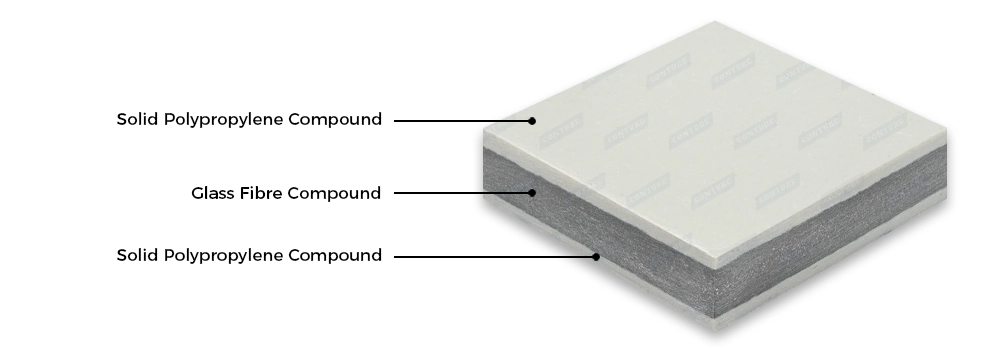
Engineered Material Composition for Superior Performance
Our panels are precision-engineered from a proprietary composite of virgin polypropylene (PP) reinforced with glass fibers. This advanced formulation synergistically combines the inherent benefits of PP—such as chemical resistance and low moisture absorption—with the enhanced structural strength, rigidity, and dimensional stability provided by fiber reinforcement. The result is a material with demonstrably superior mechanical properties compared to standard alternatives.
Exceptional Surface Finish for Reduced Labor Costs
The panel features an ultra-smooth, non-porous polypropylene surface that consistently delivers an outstandingly smooth concrete finish. This high-quality finish significantly minimizes or even eliminates the need for post-demoulding plastering and surface remediation, directly translating to reduced labor time, material costs, and faster project completion timelines.
Outstanding Durability and Operational Flexibility
The material exhibits excellent plasticity and controlled bendability, allowing it to accommodate specific architectural contours without sacrificing integrity. Designed for extreme longevity, each panel is engineered to be reused up to 300 cycles under normal conditions, offering exceptional lifetime value and reducing material waste.
Superior Resistance to Environmental and On-Site Hazards
The core polypropylene material is inherently highly resistant to water and moisture absorption. This ensures the panels will not swell, warp, or delaminate when exposed to wet weather or humid conditions, guaranteeing consistent performance and dimensional accuracy. Furthermore, the composite is highly resistant to cracking, pest infestation, and corrosion from common acids, alkalis, and chemicals found on construction sites.
Enhanced Safety, Sustainability, and Maintainability
Safety and environmental responsibility are integral to our design. The panels are manufactured from recyclable materials and are inherently flame-resistant, contributing to safer job sites and compliance with stringent green building standards. Additionally, their robust construction allows for straightforward repair and maintenance, further extending service life and lowering total cost of ownership.

| Technical Properties | Test Method | Specifications | ||||
Dimensions (MM) | N/A | Variable as per request Length: up to 5400mm, Width: up to 900mm Thickness: 10mm, up to 30mm with intervals each 0.5mm | ||||
| Modulus of Elasticity | ISO 178:2019 (MPA) | 10mm | 12mm | 15mm | 18mm | 20mm |
| 5400 | 5250 | 5050 | 5000 | 4700 | ||
| Vicat Softening Temperature | ISO 306:2022 (℃) | 95℃ | ||||
| Static Bending | ISO 178:2019 (MPA) | 10mm | 12mm | 15mm | 18mm | 20mm |
| 49.5 | 50.2 | 51.8 | 52.2 | 54.7 | ||
| Water Absorption Rate | ISO 62:2008 | <0.5% | ||||
| Usage Life Times | N/A | 300+ | ||||
| Stripping | N/A | No release agent required in standard conditions | ||||